

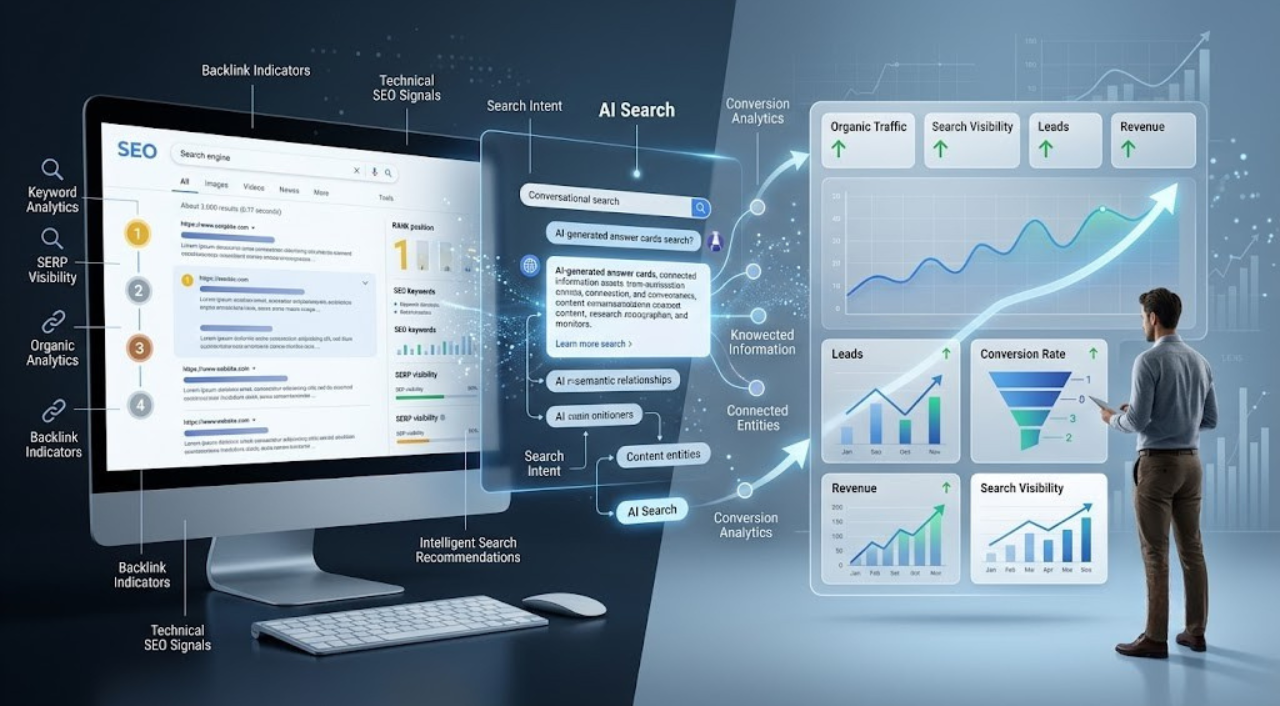
Search has changed dramatically.
People no longer rely on a traditional Google results page for every question. They use AI-powered search experiences, voice assistants, social platforms, videos, maps, forums, and conversational tools to discover information and businesses.
So, Why SEO Still Matters in 2026?
Absolutely—but SEO has evolved.
Modern Search Engine Optimization is no longer just about inserting keywords into a webpage and building as many backlinks as possible. It is about creating useful content, building authority, delivering a strong user experience, understanding search intent, and making your brand discoverable across increasingly diverse search experiences.
Google’s current guidance continues to emphasize helpful, reliable, people-first content rather than content created primarily to manipulate search rankings.
For businesses, the opportunity is significant. A well-executed SEO strategy can increase organic visibility, attract qualified visitors, generate leads, strengthen brand credibility, and contribute to revenue over the long term.
In this guide, we will explore why SEO still matters in 2026, the techniques that matter most, how AI is changing search, and how businesses can turn search visibility into measurable business results.
What Is SEO in 2026?
SEO, or Search Engine Optimization, is the process of improving a website and its content so that search engines can understand, discover, and potentially show it to people searching for relevant information, products, or services.
But modern SEO is broader than traditional optimization.
Traditional SEO vs. Modern SEO
| Traditional SEO | Modern SEO |
| Focused heavily on keywords | Focuses on topics and search intent |
| Keyword density | Relevance and contextual coverage |
| Quantity of backlinks | Quality and relevance of links |
| Ranking individual pages | Building topical and brand authority |
| Optimizing primarily for search engines | Optimizing for people and search systems |
| Text-focused content | Text, images, video, structured data and other formats |
| Google results page | Search, AI experiences, Maps, Discover and other discovery surfaces |
| Traffic as a primary goal | Leads, conversions and revenue |
Google’s Search Essentials continue to emphasize fundamentals such as helpful content, relevant language, crawlability, and avoiding spam practices.
This means the fundamentals remain important—but the way businesses apply them has become more sophisticated.
SEO vs. Paid Advertising
| Factor | SEO | Paid Advertising |
| Initial results | Usually slower | Usually faster |
| Ongoing cost | Requires continuous investment | Requires advertising spend |
| Long-term value | Can accumulate | Campaign-dependent |
| Targeting | Based heavily on search relevance and intent | Highly controllable audience targeting |
| Scalability | Content and authority can scale | Budget-dependent |
| Trust | Organic visibility can support credibility | Clearly identified as advertising |
| Best use | Sustainable organic growth | Immediate campaigns and demand capture |
The strongest businesses often use both.
For example, paid search can help identify which messaging and keywords convert, while SEO can build organic visibility around successful themes.
Proven SEO Techniques That Work in 2026
1. Optimize for Search Intent
One of the biggest mistakes in SEO is focusing on keywords without understanding why people search for them.
Before creating content, ask:
“What does this person actually want to accomplish?”
If someone searches for “SEO strategy,” they may expect a guide.
If they search for “SEO agency pricing,” they may want commercial information.
If they search for “SEO services near me,” they likely want local businesses.
Your page should satisfy the underlying need—not merely contain the keyword.
2. Create Helpful, Original Content
Content remains one of the foundations of SEO.
But publishing thousands of generic articles is not a strategy.
Google explicitly emphasizes content that is helpful, reliable, original, and created primarily for people.
High-quality content should ideally provide:
- Original insights
- Practical examples
- First-hand experience
- Accurate information
- Clear explanations
- Relevant data
- Expert perspectives
- Useful resources
- Updated information
Ask yourself:
If search engines disappeared tomorrow, would people still find this content useful?
If the answer is no, the content probably needs improvement.
3. Build Topical Authority
Instead of publishing unrelated articles, build a network of content around important subjects.
For example, suppose Gaffis wants to establish authority around SEO.
A central pillar page could be:
Complete Guide to SEO
Supporting articles could include:
- Technical SEO Guide
- Keyword Research Guide
- On-Page SEO
- Local SEO
- Link Building
- SEO Analytics
- AI and SEO
- SEO for E-commerce
- SEO for Small Businesses
These pages can be connected through relevant internal links.
This creates a topic cluster.
It helps users navigate your website and gives search engines more context about the subjects your site covers. Google also recommends crawlable links and descriptive anchor text to help users and search engines understand linked content.
4. Strengthen On-Page SEO
On-page SEO involves optimizing the content and structure of individual pages.
Important elements include:
Title Tag
Create a clear title that accurately describes the page.
H1
Use one clear primary heading that communicates the topic.
H2 and H3 Headings
Break complex topics into logical sections.
Keywords
Use relevant terminology naturally rather than repeating the same phrase excessively.
Internal Links
Connect related pages using descriptive anchor text.
URLs
Keep URLs concise, descriptive, and understandable.
Images
Use relevant images, descriptive filenames, appropriate alt text, and optimized file sizes.
Readability
Make content easy to scan using:
- Short paragraphs
- Descriptive headings
- Lists
- Tables
- Examples
- Visual elements
Google’s Search Essentials recommend using words people would use to look for your content and placing them in prominent, descriptive locations such as titles, headings, alt text, and link text.
5. Don’t Ignore Technical SEO
Great content cannot perform effectively if search engines cannot properly access or understand your website.
Technical SEO focuses on the infrastructure that supports search visibility.
Important areas include:
- Crawlability
- Indexability
- Website architecture
- XML sitemaps
- txt
- Canonical URLs
- HTTPS
- Mobile usability
- JavaScript rendering
- Structured data
- Website performance
Core Web Vitals
Website experience also matters.
Core Web Vitals are metrics designed to measure important aspects of user experience, including loading performance, responsiveness, and visual stability.
Google recommends achieving good Core Web Vitals, while also emphasizing that page experience is broader than any single metric.
The practical lesson is simple:
Make your website fast, stable, accessible, mobile-friendly, and easy to use.
6. Build E-E-A-T and Trust Signals
E-E-A-T stands for:
Experience
Expertise
Authoritativeness
Trustworthiness
Google’s guidance emphasizes these qualities when discussing high-quality content, particularly the importance of creating reliable, people-first information.
Businesses can strengthen trust by including:
- Author biographies
- Expert contributors
- Original research
- References and sources
- Case studies
- Customer reviews
- Transparent company information
- Contact information
- Detailed About pages
- First-hand examples
- Clear credentials where relevant
For Gaffis, for example, an article about SEO could be strengthened by including practical campaign examples, original analysis, screenshots, data, and clearly identified authors or contributors with relevant expertise.
7. Earn High-Quality Backlinks
Backlinks remain an important part of the SEO ecosystem, but the objective should not be to collect hundreds of random links.
Focus on relevance, quality, and editorial value.
Effective approaches can include:
- Digital PR
- Original research
- Industry reports
- Expert contributions
- Useful resources
- Partnerships
- Relevant guest contributions
- Data-driven content
- Link-worthy guides
Avoid buying large quantities of low-quality links or participating in manipulative link schemes.
The goal is to earn links because your content is genuinely worth referencing.
8. Invest in Local SEO
Local SEO is especially important for businesses serving specific geographic markets.
A local business should maintain accurate information through its Google Business Profile and website.
Google states that local results are primarily influenced by relevance, distance, and prominence, and that complete and accurate business information can help businesses appear for relevant local searches.
Important local SEO activities include:
- Optimizing Google Business Profile
- Keeping business information accurate
- Building relevant local citations
- Collecting genuine customer reviews
- Creating useful local landing pages
- Publishing locally relevant content
- Earning relevant local links
- Maintaining consistent business information
For example, instead of targeting only:
“digital marketing agency”
a local business might target relevant searches such as:
“digital marketing agency in Pune”
when that location is genuinely served.
How to Use AI Without Destroying SEO
AI is now an important tool for marketers.
Used correctly, it can accelerate SEO workflows.
AI can help with:
- Keyword research
- Content ideation
- Content outlines
- Competitor analysis
- Data analysis
- Content briefs
- Meta description ideas
- Content optimization
- Content gap analysis
But there is a major difference between using AI to improve content production and using AI to mass-produce low-value pages.
Google’s guidance says generative AI can be useful for research and structuring original content, but generating large numbers of pages without adding value can fall under scaled content abuse.
The right philosophy is:
AI should accelerate expertise, research, and execution—not replace originality, fact-checking, expertise, and human judgment.
For example:
Weak approach
AI generates 500 generic articles → Publish automatically → Wait for rankings.
Strong approach
Research → AI assists with analysis → Human expert adds insights → Facts verified → Content edited → Original examples added → SEO optimized → Published → Performance monitored.
The second approach creates a much stronger asset.
Keywords Still Matter—but Differently
Keywords are not dead.
Keyword strategy has evolved.
Instead of obsessing over exact-match phrases, modern SEO considers:
- Search intent
- Topic relevance
- Semantic relationships
- Long-tail queries
- Conversational searches
- Questions
- Entities
- Related concepts
For example, instead of targeting only:
“SEO”
a business could build content around:
- SEO strategy
- Technical SEO
- SEO audit
- SEO for small businesses
- Local SEO
- SEO tools
- SEO ROI
- SEO reporting
- AI and SEO
- SEO content strategy
This creates broader topical coverage.
The objective isn’t to mention every keyword.
The objective is to comprehensively answer the questions and needs surrounding a topic.
SEO ROI: How Rankings Become Revenue
One of the biggest misconceptions about SEO is that its purpose is simply to generate traffic.
Traffic is only one step.
Consider a hypothetical example.
Suppose an e-commerce website receives:
10,000 organic visitors/month
and converts:
2% of visitors
That produces:
200 conversions/month
Now imagine SEO improvements increase qualified organic traffic to:
15,000 visitors/month
while better landing pages improve conversion rate to:
2.5%
The result becomes:
375 conversions/month
That’s an increase of 175 conversions per month.
The example is hypothetical, and real-world results vary depending on industry, competition, website quality, pricing, customer journey, conversion rate, and SEO execution.
But the principle is important:
SEO value comes from improving the entire funnel, not simply increasing impressions.
Frequently Asked Questions About SEO in 2026
Is SEO still worth it in 2026?
Yes. SEO remains valuable when it is connected to search intent, useful content, technical quality, authority, and business outcomes. The major change is that SEO now needs to account for a broader search ecosystem, including AI-powered experiences.
Will AI replace traditional SEO?
AI will change SEO, but it does not eliminate the need for search optimization. Businesses still need discoverable websites, useful information, strong technical foundations, authority, and content that satisfies users.
Does Google still matter for SEO?
Yes. Google remains a major search ecosystem, while businesses should also consider other discovery channels such as social platforms, video, maps, communities, and AI-powered search.
How long does SEO take to produce results?
There is no universal timeline. Results depend on competition, website authority, technical condition, content quality, industry, resources, and strategy. SEO should generally be treated as a long-term growth investment rather than an instant traffic solution.
Are backlinks still important in 2026?
Relevant, high-quality links can contribute to discoverability, authority, and Google’s understanding of pages. However, link quantity alone is not a reliable SEO strategy. Google also uses links to discover pages and as a relevance signal.
Is AI-generated content bad for SEO?
AI-generated content isn’t automatically bad. Google focuses on the quality and purpose of content rather than simply whether AI was involved. However, using AI to mass-produce unoriginal content primarily to manipulate search rankings can violate Google’s spam policies.
What are the most important SEO ranking factors?
There isn’t a single checklist that guarantees rankings. Strong SEO generally involves useful content, relevance, technical accessibility, authority, trustworthy information, good user experience, and satisfying search intent.
How can small businesses compete with large websites?
Small businesses can compete by focusing on specific audiences, local relevance, specialized expertise, original insights, strong customer experiences, topical depth, and highly relevant long-tail searches rather than trying to compete for every broad keyword.
The Future of SEO Is About Being Useful
The biggest mistake businesses can make in 2026 is assuming that SEO is dead because search has changed.
SEO isn’t disappearing.
It is expanding.
The old approach was:
Find a keyword → create a page → build links → rank.
The modern approach is closer to:
Understand the audience → understand the intent → create genuinely useful information → build authority → provide an excellent experience → make the content technically accessible → measure business outcomes → improve continuously.
This is a much more sophisticated discipline.
And it is also more valuable.
Businesses that invest in genuine expertise, useful content, technical quality, customer experience, and brand authority are building assets that can remain valuable even as search interfaces continue to evolve.
Conclusion
SEO still matters in 2026 because people still need to discover information, products, services, and businesses.
What has changed is the environment in which that discovery happens.
Search now includes traditional results, AI-powered experiences, Maps, Discover, video, social platforms, and conversational interfaces.
That means businesses need to think beyond rankings.
Successful SEO in 2026 is about:
Visibility + Relevance + Authority + Trust + User Experience + Business Results
The businesses most likely to benefit are not those trying to exploit the latest algorithm loophole.
They are the businesses consistently creating something people actually want to find.
For businesses looking to strengthen their digital presence, Gaffis.com can serve as a resource for practical digital marketing insights and strategies designed around measurable growth.
The future of SEO isn’t about gaming search engines.
It’s about becoming the best answer—and the most trustworthy choice—for the people you want to reach.