


Content Marketing vs SEO is one of the biggest debates in digital marketing today. Businesses often ask whether they should invest in creating valuable content, focus on search engine optimization, or combine both strategies for maximum return on investment (ROI). The answer isn’t as straightforward as choosing one over the other—it depends on your business goals, industry, audience, and long-term growth strategy.
In today’s AI-driven search landscape, simply publishing blog posts or optimizing web pages is no longer enough. Google’s Helpful Content System, AI-powered search experiences, and evolving user behavior demand a smarter, more integrated approach. Companies that understand how SEO and content marketing complement each other consistently achieve higher rankings, stronger brand authority, and sustainable organic traffic.
Whether you’re a startup, local business, enterprise, or eCommerce brand, understanding the strengths and limitations of each strategy can help you allocate your marketing budget more effectively. In this comprehensive guide, we’ll break down the differences between content marketing and SEO, compare their ROI, explore real-world examples, and explain how combining both can maximize your digital success in 2026 and beyond.
By the end of this article, you’ll know:
- What Content Marketing really is
- What SEO actually involves in 2026
- How each strategy impacts long-term ROI
- Which delivers faster results
- Which is more cost-effective
- When to choose one over the other
- Why combining both creates the strongest marketing strategy
 What is Content Marketing?
Content marketing is a long-term digital marketing strategy focused on creating, publishing, and distributing valuable, relevant, and consistent content to attract and retain a clearly defined audience.
Instead of directly promoting products or services, content marketing educates, informs, entertains, and solves customer problems. This approach builds trust over time, making potential customers more likely to choose your brand when they are ready to make a purchase.
Common content marketing formats include:
- Blog articles
- Case studies
- Whitepapers
- Videos
- Infographics
- Podcasts
- Social media posts
- Email newsletters
- Webinars
- E-books
Primary Goals of Content Marketing
- Build brand awareness
- Educate potential customers
- Increase website engagement
- Generate qualified leads
- Improve customer loyalty
- Support SEO efforts
- Increase conversions
Benefits of Content Marketing
✔ Builds trust with your audience
✔ Creates evergreen traffic
✔ Increases brand authority
✔ Supports every stage of the customer journey
✔ Generates backlinks naturally
✔ Improves conversion rates
✔ Enhances customer retention
However, without proper SEO optimization, even the best content may struggle to reach its intended audience.
What is SEO?
Search Engine Optimization (SEO) is the process of improving a website’s visibility in organic search results on Google, Bing, and AI-powered search engines. Its primary goal is to help your website rank higher for relevant keywords so that potential customers can find your business without relying solely on paid advertising.
Unlike traditional marketing, SEO focuses on understanding user intent, optimizing website content, improving technical performance, and building authority to earn sustainable, long-term traffic.
In 2026, SEO is no longer just about keywords. It has evolved into a comprehensive strategy that combines technical excellence, high-quality content, user experience (UX), authority building, and AI search optimization.
Core Components of SEO
1. On-Page SEO
On-page SEO focuses on optimizing the elements within your website, including:
- Title tags
- Meta descriptions
- Header tags (H1, H2, H3)
- Keyword placement
- Image optimization
- Internal linking
- Content quality
- URL structure
- Schema markup
These elements help search engines understand your content while improving the user experience.
2. Technical SEO
Technical SEO ensures your website is easy for search engines to crawl, index, and rank.
Important technical factors include:
- Website speed
- Mobile responsiveness
- HTTPS security
- XML sitemaps
- txt
- Core Web Vitals
- Canonical tags
- Structured data
- Crawlability
- Indexability
Without strong technical SEO, even excellent content may struggle to perform.
3. Off-Page SEO
Off-page SEO builds your website’s authority through external signals, such as:
- High-quality backlinks
- Digital PR
- Brand mentions
- Local citations
- Guest blogging
- Social signals
- Online reviews
Search engines interpret these signals as indicators of trust and credibility.
4. Local SEO
For businesses targeting specific geographic areas, Local SEO is essential.
It includes:
- Google Business Profile optimization
- Local citations
- NAP consistency (Name, Address, Phone)
- Local keywords
- Customer reviews
- Location-specific landing pages
Local SEO helps businesses appear in Google Maps and local search results, driving nearby customers to their services.
5. AI SEO & Answer Engine Optimization (AEO)
As AI-powered search tools like ChatGPT, Google AI Overviews, Gemini, and Perplexity become more common, SEO now includes optimizing content for answer engines.
Key strategies include:
- Clear question-and-answer formats
- Structured headings
- FAQ sections
- Entity-based optimization
- Schema markup
- EEAT (Experience, Expertise, Authoritativeness, Trustworthiness)
- Semantic keyword usage
These practices increase the chances of your content being featured in AI-generated answers and rich search results.
Benefits of SEO
A well-executed SEO strategy provides long-term advantages:
- Consistent organic traffic
- Higher search rankings
- Increased brand credibility
- Lower customer acquisition costs
- Better user experience
- Sustainable lead generation
- Improved conversion rates
- Higher return on marketing investment
Unlike paid advertising, SEO continues delivering value long after the initial optimization work is complete.
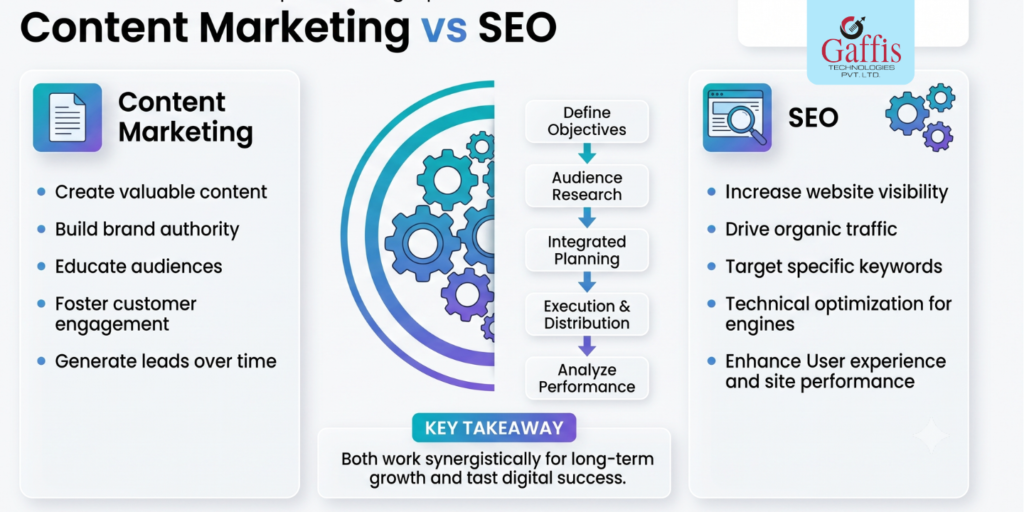
Content Marketing vs SEO: Understanding the Difference
Many businesses mistakenly believe content marketing and SEO compete with each other. In reality, they serve different purposes and are most effective when combined.
Think of it this way:
- SEO helps people find your content.
- Content marketing gives them a reason to stay, trust, and convert.
SEO attracts visitors, while content marketing builds relationships with those visitors.
Content Marketing vs SEO Comparison Table
| Feature | Content Marketing | SEO |
| Primary Goal | Educate, engage, and build trust | Increase search visibility and rankings |
| Focus | Audience value | Search engine optimization |
| Traffic Source | Blogs, social media, email, referrals | Organic search |
| Time to Results | Medium to Long | Medium to Long |
| Cost | Content creation and promotion | Technical optimization and ongoing SEO |
| Builds Authority | Yes | Yes |
| Generates Leads | Yes | Yes |
| Improves Rankings | Indirectly | Directly |
| Requires Keyword Research | Helpful | Essential |
| Long-Term Value | Excellent | Excellent |
| AI Search Friendly | Yes (if optimized) | Yes |
| Evergreen Potential | High | High |
SEO vs Content Marketing: Key Differences
1. Purpose
SEO is designed to improve visibility in search engines.
Content marketing is designed to educate and nurture potential customers.
2. Approach
SEO focuses on optimization techniques.
Content marketing focuses on storytelling, education, and value creation.
3. Success Metrics
SEO measures:
- Keyword rankings
- Organic traffic
- Click-through rate (CTR)
- Search impressions
- Conversions from organic traffic
Content marketing measures:
- Engagement
- Time on page
- Shares
- Leads generated
- Brand awareness
- Customer loyalty
4. Audience Focus
SEO starts with search intent.
Content marketing starts with audience needs.
The strongest digital strategies combine both perspectives.
5. Longevity
A well-optimized article can generate traffic for years.
A valuable piece of content can continue attracting backlinks, shares, and customers indefinitely.
Together, they create compounding returns over time.
How Content Marketing and SEO Work Together
Instead of asking which strategy is better, businesses should ask how they can combine them effectively.
Here’s a simple workflow:
- Conduct keyword research.
- Identify user intent.
- Create high-quality, informative content.
- Optimize the content for SEO.
- Publish and promote it.
- Build backlinks.
- Update the content regularly.
- Measure performance and improve.
This integrated approach ensures your content is discoverable, valuable, and capable of driving long-term business growth.
Real-World Example
Imagine a company offering digital marketing services.
Without SEO:
- The company publishes excellent blog posts.
- Few people discover them.
- Traffic remains low.
Without content marketing:
- The website ranks for keywords.
- Visitors find the pages.
- They leave quickly because the content lacks depth or value.
With both:
- SEO drives qualified visitors.
- High-quality content answers their questions.
- Visitors trust the brand.
- They spend more time on the site.
- Conversions increase.
- The website earns backlinks.
- Rankings improve further.
This creates a continuous cycle of growth.
Why Google Rewards This Combination
Google’s algorithms prioritize websites that provide helpful, trustworthy, and relevant content while offering a positive user experience.
By combining SEO with content marketing, businesses can:
- Improve topical authority
- Increase dwell time
- Reduce bounce rates
- Earn natural backlinks
- Enhance EEAT signals
- Build long-term trust with both users and search engines
This synergy leads to stronger rankings and more sustainable organic growth.